
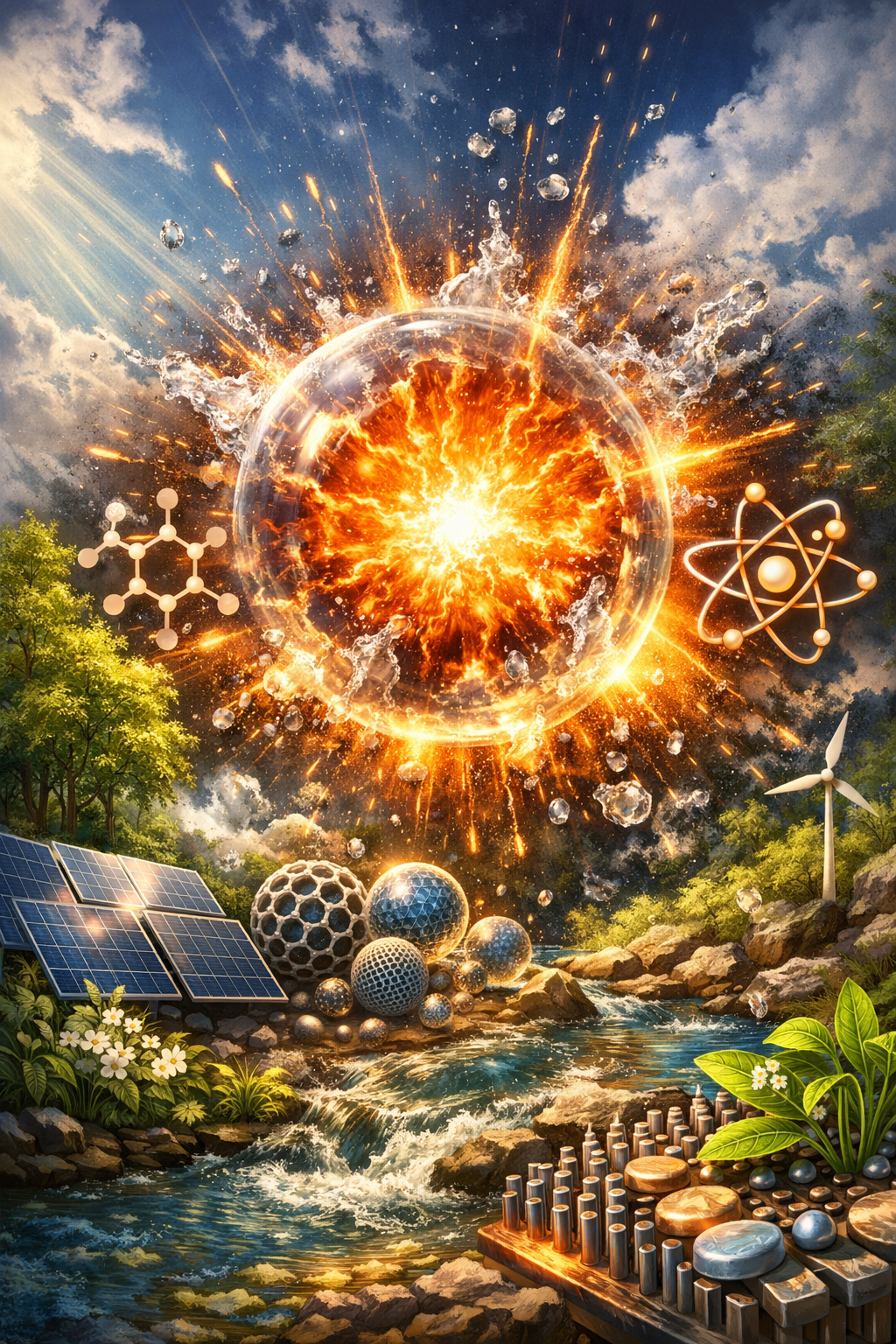
A few years ago, in my travels I met a small group of people with big plans for a farm operation. Not just any farm operation, this one is a hybrid research institute and a form of digital sovereignty model. As a consequence of these very interesting topics, I dove in deeply for the following years up to today. I would never imagine the central piece of it all would be this one tiny thing.
A bubble. Did you know?
A single collapsing bubble can unleash temperatures hotter than stars, a reminder that even the smallest structures in nature hold the power to transform their environment.
Now you may wonder… what’s so cool about this bubble thing?
Actually first, let’s learn what we mean here when I repeatedly will mention “nano” this and “nano” that. If you already know, you can keep scrolling down, if you don’t, stay and understand something.
Nano simply refers to things so small that you can’t see them — but they still shape your environment in big ways. Think of it like this:
You don’t see dust in the air, but you breathe it. You don’t see chemicals in water, but they affect your health. You don’t see the tiny particles from plastics, metals, or pollution — but they’re part of your daily exposure.
That invisible layer of life is what scientists call the exposome — the sum of everything you’re exposed to in your environment.
And “nano” is the scale where many of those exposures happen.
So when we talk about nanotechnology, we’re talking about tools that work at the same tiny scale as the things that influence your air, your water, your soil, your home, and your overall quality of life.
Nano isn’t about being small. It’s about working at the level where the environment actually touches you.
Now I’ll tell you what’s cool about this
From a single collapsing bubble, we come to discover a whole universe of possibilities — tools that help us clean our water, design greener materials, and understand the invisible exposures that shape our lives. Your children’s life. Your parents health. Your babies development.
When a bubble collapses, it doesn’t just pop — it unleashes a tiny burst of energy powerful enough to reshape the world around it. And that’s where things get captivating. Because this microscopic event can be harnessed in ways that help us clean, restore, and regenerate the environments we depend on every day.
Think of it like nature’s own nano‑hammer: small, precise, and capable of breaking down stubborn contaminants that normally resist traditional cleanup methods.
Beyond the flash of light and the shockwave, this phenomena can be harnessed to create energy efficient solutions to life contamination. And well, you are very likely living in an infrastructure that is less than fit for human healthy development – so you should care.
One of the most surprising advantages is consistency. Harnessed correctly, cavitation can produce extremely uniform nano‑scale effects — the kind of repeatability that industries dream about for their products. Whether you’re mixing, cutting, cleaning, or structuring materials, consistency at the nano level means stronger composites, purer extracts, and more reliable performance.
And here’s the part that feels almost futuristic: it’s energy‑efficient. Instead of relying on high heat, harsh chemicals, or massive mechanical force, controlled cavitation uses the physics of the bubble itself — letting nature do the heavy lifting.
This is where innovators like NanoSpire come into the picture. Their published work explores how high‑shear, cavitation‑driven systems can reshape materials with remarkable precision. It’s the kind of technology that could help industries:
- break down stubborn contaminants in water
- extract plant‑based compounds more cleanly
- create greener, more efficient manufacturing steps
- reduce waste and chemical use
- support environmental remediation efforts
All from the controlled collapse of a microscopic bubble.
Examples of Nano-Tech Applications
1. Breaking down pollutants in water
High‑shear cavitation systems can help degrade certain environmental contaminants, making water treatment more efficient and less chemical‑dependent. Unfortunately, often there is chemical runoff sites that need this kind of treatment.
2. Supporting greener, plant‑based materials
Nanotech can help extract useful compounds from plants more efficiently, leading to cleaner coatings, biodegradable materials, and eco‑friendly industrial products. This results in a healthier local home life, where some materials are not longer slowly and progressively leeching toxins into your environment.
3. Helping remove or reduce heavy metals from environments
Some engineered nanomaterials can bind to heavy metals in soil or water, helping environmental teams separate and manage those contaminants more efficiently during remediation projects. It’s a bit like giving chemistry and enzymatic reactions a precision tool — the nano‑scale structure increases surface area and reactivity, making cleanup processes faster and more targeted.
4. Creating smarter environmental sensors
Nanotechnology allows us to detect pollutants at extremely low levels, helping us understand our exposome — the total set of environmental exposures that shape our lives. This is done by having the capacity to produce ultra-sensitive sensors from nano-tech precision and scale.
5. Enabling cleaner industrial processes
Nanotech‑enhanced catalysts can reduce waste, lower emissions, and make manufacturing more sustainable. This one is interesting, what if every industrial chemical plant had a high‑shear, cavitation‑driven system to make their products or waste less toxic. Just as we all have to have a catalytic convertor in our vehicle, have you even wondered why?
So yeah… “nano” might be tiny, but it’s quietly shaping your exposome around you. Knowing that the technology is out there, wouldn’t you like less toxins for your body?
One last thing…
If you read the whole thing, you’re pretty cool.
No responses yet